
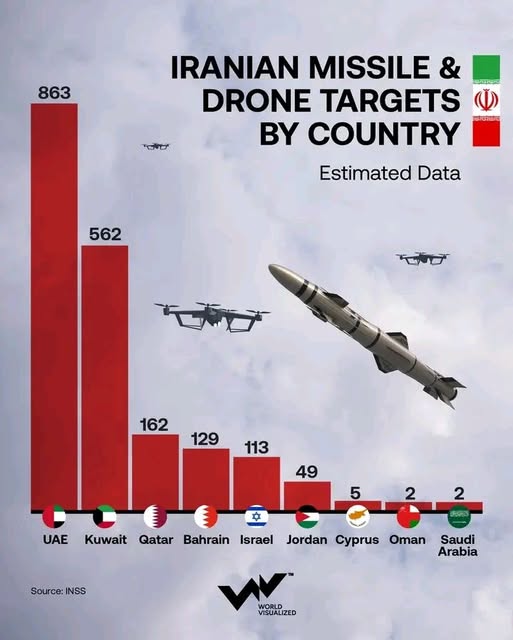

If several countries in the Middle East are linked to the U.S., why does Iran keep hitting the UAE the most?
It comes down to impact, access, and visibility.
First is impact. The UAE is not just another Gulf state. Cities like Dubai and Abu Dhabi sit at the center of global trade, aviation, and finance. When something happens there, the effect travels fast across markets, flights, and business flows. Striking the UAE sends a louder message to the world than hitting less connected locations.
Second is proximity. The UAE is one of the closest countries to Iran across the Gulf. That makes it easier to reach with drones and missiles compared to targets deeper in the region. Shorter distance means quicker strikes and fewer complications.
Third is strategic signalling. The UAE maintains strong security ties with the United States and has also built visible regional partnerships, including with Israel. From Iran’s perspective, that places the UAE in a category of countries seen as aligned, even if it is not directly fighting.
Then there is a calculation of risk. Targeting the UAE creates global attention, but still avoids the immediate escalation that could come from striking larger or more heavily militarised countries in the region. It is pressure without crossing certain lines too quickly.
There is also an economic angle. The UAE has long been a major trade gateway for Iran itself. Disrupting it raises the stakes, not just for rivals, but for the wider economic system tied to the Gulf.
Put simply, Iran is not choosing the UAE at random.
It is choosing the place where one strike is seen everywhere, felt economically, and sends the clearest signal without triggering instant full-scale escalation.